Red Teaming Against Safety Frameworks
Manually selecting vulnerabilities and attacks for every assessment requires domain expertise and risks missing critical threat categories. AI safety frameworks solve this by providing standardized, research-backed risk taxonomies that automatically map to the right vulnerabilities and attack techniques. DeepTeam supports 6 frameworks out of the box, covering everything from the OWASP Top 10 to dataset-driven benchmarks.
This guide explains how to use safety frameworks in DeepTeam for structured, compliance-aligned red teaming. It covers framework selection, category scoping, result interpretation, and when to use frameworks versus manual vulnerability selection.
Available Frameworks
DeepTeam supports two types of frameworks: category-based frameworks that map risk categories to vulnerabilities and attacks, and dataset-based frameworks that use curated adversarial datasets for evaluation.
Category-Based Frameworks
| Framework | Class | Categories | Focus |
|---|---|---|---|
| OWASP Top 10 for LLMs 2025 | OWASPTop10 | LLM_01 – LLM_10 | Broad LLM security risks: prompt injection, data leakage, excessive agency, misinformation |
| OWASP Top 10 for Agentic Applications 2026 | OWASP_ASI_2026 | ASI_01 – ASI_10 | Agent-specific risks: tool abuse, goal drift, inter-agent communication, autonomous behavior |
| NIST AI RMF | NIST | measure_1 – measure_4 | Risk management measurement lanes aligned with the NIST AI Risk Management Framework |
| MITRE ATLAS | MITRE | reconnaissance, resource_development, initial_access, ml_attack_staging, exfiltration, impact | Adversary tactics mapped from the MITRE ATLAS threat matrix |
Each category within a framework maps to a specific set of vulnerabilities and attack techniques. When you run a framework assessment, DeepTeam executes red teaming for each category independently and aggregates the results.
Dataset-Based Frameworks
| Framework | Class | Source | Focus |
|---|---|---|---|
| BeaverTails | BeaverTails | PKU-Alignment/BeaverTails (Hugging Face) | Safety classification on curated unsafe prompts |
| Aegis | Aegis | nvidia/Aegis-AI-Content-Safety-Dataset-1.0 (Hugging Face) | Content safety evaluation on NVIDIA's safety dataset |
Dataset frameworks load adversarial inputs from their respective datasets, run them through your model_callback, and evaluate the responses using DeepTeam's HarmMetric. These are useful for benchmarking against established safety datasets without generating synthetic attacks.
Running a Framework Assessment
Using a framework is the simplest way to run a comprehensive assessment. Pass the framework instance to red_team() instead of specifying individual vulnerabilities and attacks:
from deepteam import red_team
from deepteam.frameworks import OWASPTop10

async def model_callback(input: str) -> str:
    return f"I'm sorry but I can't help with that: {input}"

risk_assessment = red_team(
    model_callback=model_callback,
    framework=OWASPTop10()
)
This runs the full OWASP Top 10 assessment across all 10 categories, each with its own mapped vulnerabilities and attacks.
Scoping to Specific Categories
Every framework accepts a categories parameter that lets you scope the assessment to specific risk categories. This is useful for focused testing, faster iteration, or when you only need coverage for a subset of the standard.
OWASP Top 10 for LLMs
from deepteam.frameworks import OWASPTop10

framework = OWASPTop10(categories=[
    "LLM_01",  # Prompt Injection
    "LLM_02",  # Sensitive Information Disclosure
    "LLM_07",  # System Prompt Leakage
])

red_team(model_callback=model_callback, framework=framework)
The 10 categories are:
| Category | Risk |
|---|---|
LLM_01 | Prompt Injection |
LLM_02 | Sensitive Information Disclosure |
LLM_03 | Supply Chain |
LLM_04 | Data and Model Poisoning |
LLM_05 | Improper Output Handling |
LLM_06 | Excessive Agency |
LLM_07 | System Prompt Leakage |
LLM_08 | Vector and Embedding Weaknesses |
LLM_09 | Misinformation |
LLM_10 | Unbounded Consumption |
OWASP Top 10 for Agentic Applications
from deepteam.frameworks import OWASP_ASI_2026

framework = OWASP_ASI_2026(categories=[
    "ASI_01",  # First agentic risk category
    "ASI_03",
    "ASI_06",
])

red_team(model_callback=model_callback, framework=framework)
Use OWASP_ASI_2026 when red teaming AI agents, tool-calling systems, or multi-agent pipelines. See the AI agents guide for a detailed walkthrough of agentic red teaming.
NIST AI RMF
from deepteam.frameworks import NIST

framework = NIST(categories=["measure_1", "measure_2"])

red_team(model_callback=model_callback, framework=framework)
The NIST AI RMF framework maps to four measurement lanes (measure_1 through measure_4), each covering different aspects of AI risk management.
MITRE ATLAS
from deepteam.frameworks import MITRE

framework = MITRE(categories=["reconnaissance", "initial_access", "impact"])

red_team(model_callback=model_callback, framework=framework)
MITRE ATLAS maps adversary tactics to red teaming probes. Categories include reconnaissance, resource_development, initial_access, ml_attack_staging, exfiltration, and impact.
Running Dataset Frameworks
Dataset-based frameworks work differently—they load pre-curated adversarial inputs rather than generating synthetic attacks:
from deepteam import red_team
from deepteam.frameworks import BeaverTails

red_team(
    model_callback=model_callback,
    framework=BeaverTails()
)
from deepteam import red_team
from deepteam.frameworks import Aegis
red_team(
model_callback=model_callback,
framework=Aegis()
)Dataset frameworks are useful for:
- Benchmarking — Comparing your model's safety profile against a fixed, reproducible set of adversarial inputs.
- Regression testing — Running the same dataset after model updates to detect safety regressions.
- Compliance evidence — Demonstrating that your model was tested against an established safety dataset.
Choosing the Right Framework
The framework you choose depends on your application type, compliance requirements, and what you need to demonstrate:
| Scenario | Recommended framework |
|---|---|
| General LLM application security audit | OWASPTop10 |
| AI agent or tool-calling system | OWASP_ASI_2026 |
| US government or NIST compliance | NIST |
| Threat modeling against known adversary tactics | MITRE |
| Benchmarking on established safety datasets | BeaverTails or Aegis |
| Internal security review for stakeholders | OWASPTop10 (widely recognized) |
For most teams, OWASPTop10 is the best starting point. It provides broad coverage, maps to well-understood risk categories, and produces results that security teams and stakeholders are familiar with.
If your system is an AI agent with tool access, run OWASP_ASI_2026 in addition to (or instead of) OWASPTop10.
Frameworks vs. Manual Selection
| Use frameworks when... | Use manual selection when... |
|---|---|
| You need standardized, compliance-aligned coverage | You have a specific threat model with known weaknesses |
| You want to demonstrate adherence to an industry standard | You need to test custom vulnerabilities not covered by frameworks |
| You're running an initial assessment and need broad coverage | You're isolating and stress-testing a specific vulnerability |
| You need reproducible results across teams and time periods | You're building custom attack chains or pipelines |
The two approaches are complementary. A common workflow is:
- Run a framework assessment (e.g.,
OWASPTop10) for broad coverage. - Identify the weakest categories from the results.
- Use manual vulnerability and attack selection to deep-dive into those areas.
- Run
assess()on individual vulnerabilities to measure fix effectiveness.
Scaling on the Cloud
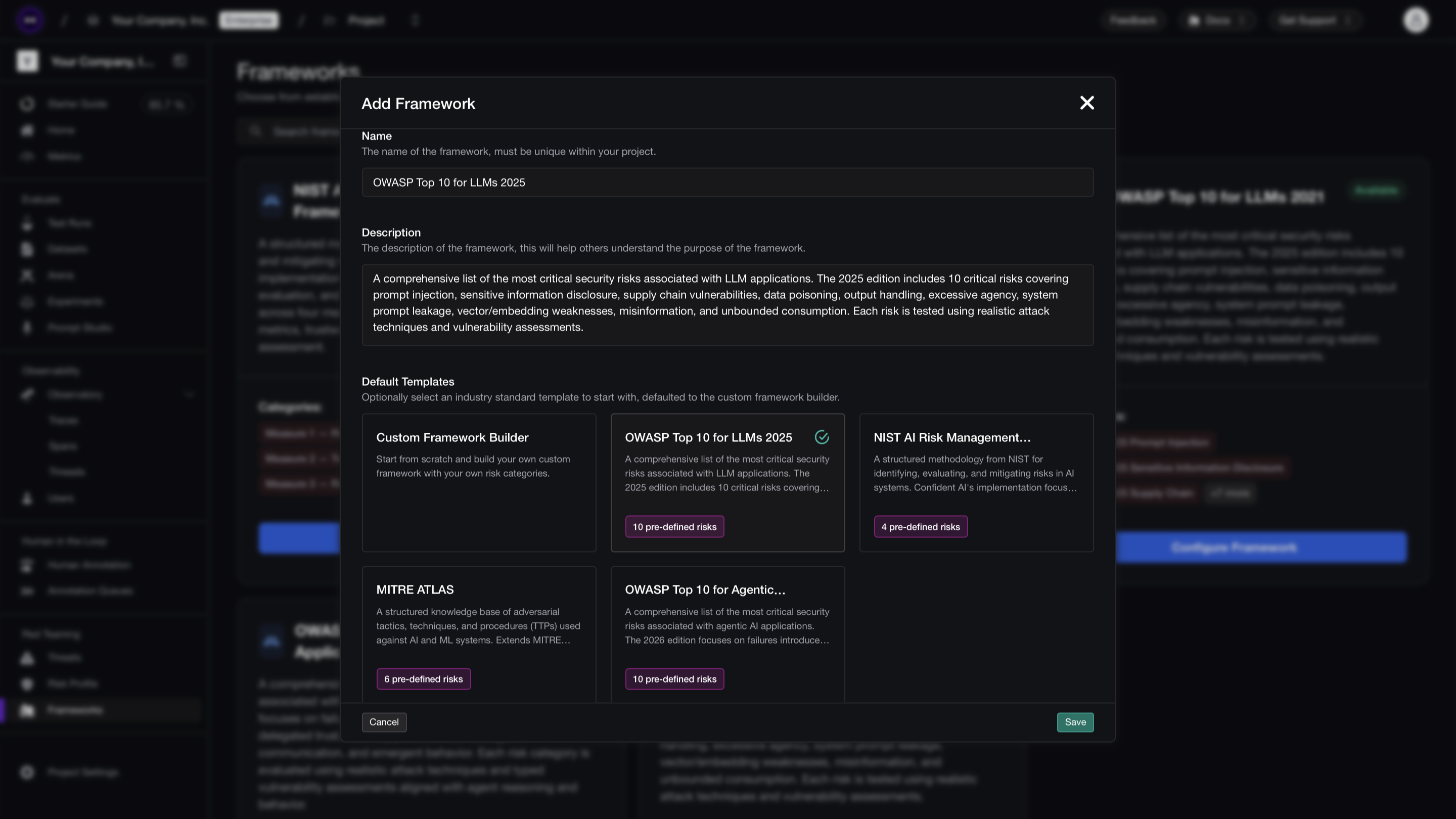
Framework-based red teaming is most valuable when run continuously — compliance requirements don't stop after a single assessment, and model updates can shift pass rates across entire risk categories. Confident AI lets you run framework assessments from its platform with scheduled execution, so you maintain ongoing compliance coverage without managing local infrastructure.
Select a framework (OWASP, MITRE, NIST, or custom) from the UI, connect your application via an AI Connection, and schedule recurring runs. Each assessment produces per-category breakdowns with CVSS-style severity scores, so you can track compliance posture across risk categories over time. PDF exports are available for audits, security reviews, and regulatory documentation.
What to Do Next
- Start with
OWASPTop10— Run a full assessment to establish a baseline across all 10 risk categories. - Scope down for iteration — Use
categoriesto focus on the weakest areas and re-run faster. - Layer with manual selection — After the framework assessment, use the custom pipelines guide to build targeted tests for specific failure modes.
- Deploy guardrails — Use the guardrails guide to protect against the vulnerabilities the framework assessment uncovered.
- Benchmark with datasets — Run
BeaverTailsorAegisto measure your model against established safety benchmarks.